17 Ways to Organize a Small House Without Buying More Stuff
If you live in a small house, you’ve probably been told that the answer to your clutter problem is more storage.
More baskets. More bins. More shelves. More drawer organizers. More cute little containers that somehow cost $14.99 each.
But after living in smaller spaces with a big family, I’ve learned that buying more things to organize all of our things usually isn’t the answer.
Sometimes it actually makes the problem worse.
When you don’t have a ton of square footage to work with, every single thing you bring into your house has to live somewhere. Even the organizing supplies need a home.
The good news is that you probably already have everything you need to make your house feel significantly more organized.
Before you order another set of matching baskets, try these 17 ways to organize a small house without buying more stuff.
1. Declutter Before You Organize Anything
This is always where I start.
You cannot organize your way out of having too much stuff.
You can buy beautiful bins and perfectly label every shelf, but if your cabinets are packed so tightly that things fall out every time you open the door, you still have a clutter problem.
Pick one small area and remove everything you don’t use, need, or genuinely want.
Don’t start with your entire house. Start with one kitchen cabinet, one bathroom drawer, or one shelf.
Getting rid of even 20 percent of what’s crammed into a space can make a surprisingly big difference.
2. Stop Saving Things for “Someday”
Small houses don’t have a lot of room for someday.
Someday I might use this.
Someday one of the kids might need this.
Someday I might start this hobby again.
Someday I might find the missing lid.
Meanwhile, all of those someday items are taking up space that you need today.
I’m not saying you should get rid of everything you aren’t currently using. Seasonal items and things you know you’ll need later obviously make sense to keep.
But if you haven’t used something in years and you’re keeping it because there’s a tiny chance you’ll need it someday, ask yourself whether that tiny chance is worth the space it’s taking up right now.
3. Give Everything a Home
One of the biggest reasons clutter piles up is because the stuff doesn’t actually have anywhere to go.
The mail lands on the counter.
Shoes collect by the door.
Chargers migrate around the house.
Random toys sit on the kitchen table.
Before you try to organize something, ask yourself a very simple question:
Where does this live?
If you can’t answer that, that’s the problem you need to solve.
The solution doesn’t have to be fancy. You just need one consistent place where that item goes when you’re finished using it.
4. Use the Containers You Already Own
Before buying organizing bins, walk around your house and see what you already have.
I can almost guarantee you have containers somewhere.
Empty shoe boxes can organize craft supplies. Mason jars can hold small items. An old basket can collect toys. Food storage containers that have lost their lids can become drawer organizers.
Even small cardboard boxes can divide a messy junk drawer.
They don’t have to match.
They don’t have to look Pinterest perfect.
They just have to work.
5. Take Things Out of Their Original Packaging
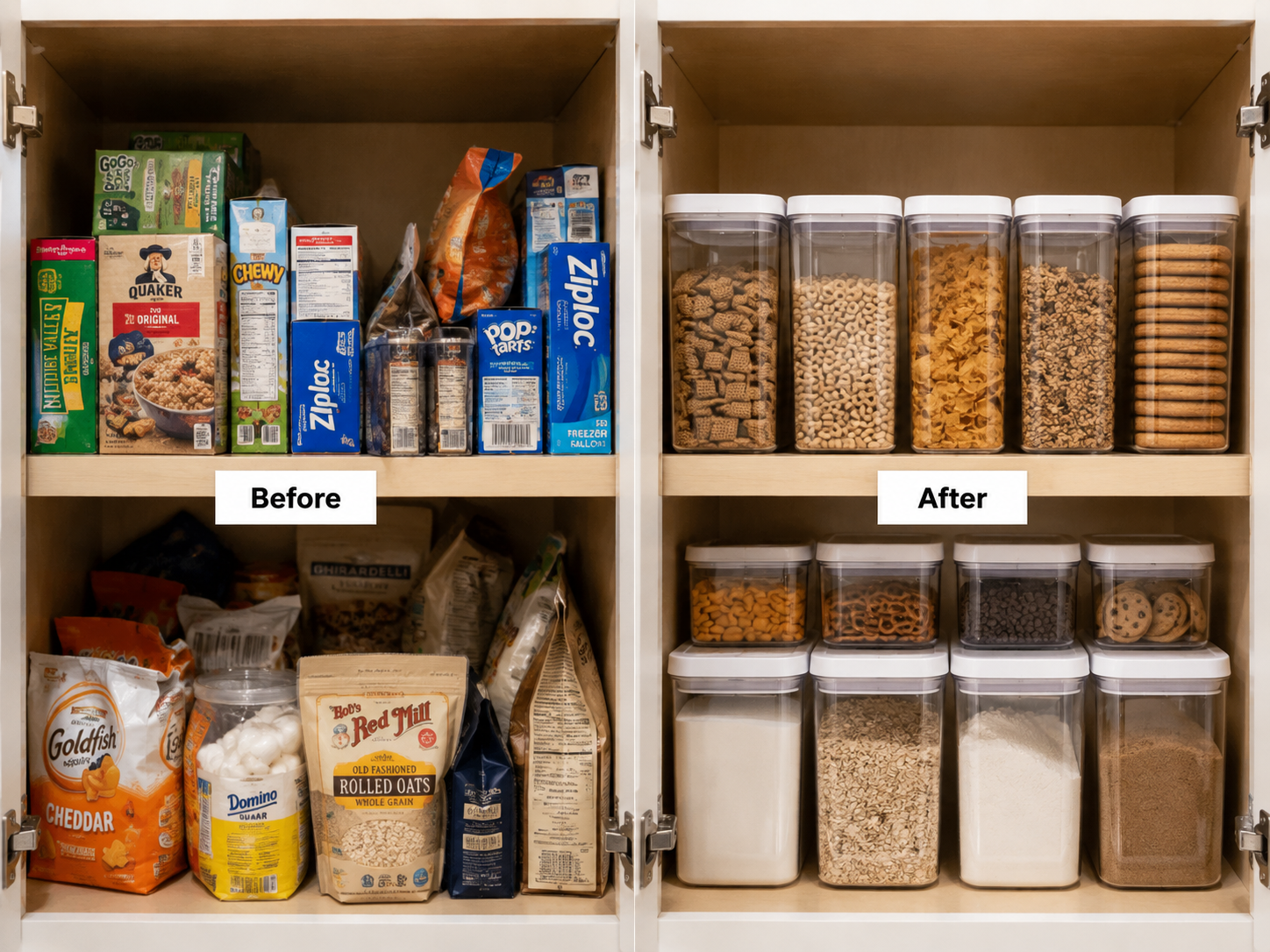
Packaging takes up a ridiculous amount of space.
This is especially noticeable in small kitchens and bathrooms.
Snack boxes, individually packaged pantry items, toiletries, cleaning products, and other household supplies can sometimes take up far less room once you remove unnecessary outer packaging.
I’m not suggesting transferring everything into matching containers. That would defeat the purpose of organizing without buying more stuff.
Just look for bulky packaging you can eliminate.
Sometimes removing three cardboard boxes from one cabinet suddenly gives you an entire shelf back.
6. Store Things Where You Actually Use Them
This sounds obvious, but it’s something I have to remind myself of constantly.
Organizing systems fail when they’re inconvenient.
If you’re always walking across the house to put something away, there’s a good chance you’re eventually going to stop putting it away.
Store things as close as possible to where they’re actually used.
Keep coffee supplies near the coffee maker.
Keep towels near the bathroom.
Keep homework supplies where your kids usually work.
Keep frequently used cooking tools close to your main prep area.
Your house doesn’t have to be organized according to some imaginary rule about where things are “supposed” to go.
Organize it according to how your family actually lives.
7. Use Empty Vertical Space
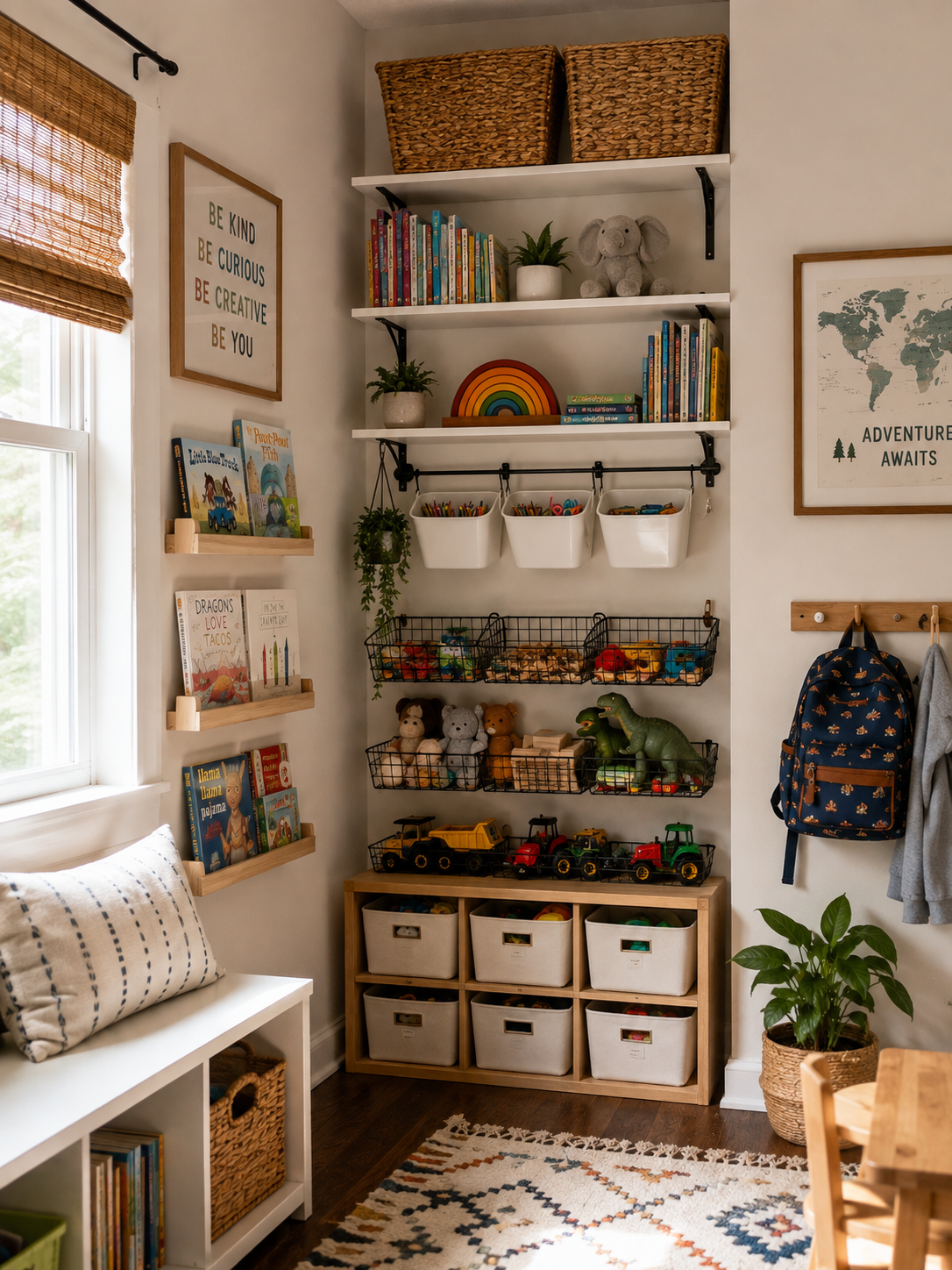
When floor space is limited, start looking up.
You might have far more storage space than you realize simply because you’re only using the bottom half of cabinets, closets, and shelves.
Stack things that can safely be stacked.
Move rarely used items higher.
Use the tops of existing cabinets or furniture when it makes sense.
You don’t necessarily need to install new shelves or buy fancy vertical organizers. Sometimes rearranging what you already own is enough to make better use of the height you have.
8. Stop Giving Prime Storage Space to Things You Rarely Use
The easiest-to-reach storage areas in your house should be reserved for the things you use the most.
Yet somehow we end up with the waffle maker we use twice a year sitting front and center while the things we use every day are crammed behind it.
Take a look at your most convenient cabinets, drawers, and shelves.
What is living there?
Move rarely used items to the harder-to-reach areas and give that prime real estate to your everyday stuff.
This one change can make a small house function so much better without adding a single storage product.
9. Create a Donation Box
Keep a cardboard box somewhere out of the way for donations.
Whenever you find something you don’t want anymore, put it directly into the box.
A shirt that doesn’t fit?
Donation box.
Toy nobody plays with?
Donation box.
Kitchen gadget you forgot you owned?
Donation box.
When the box is full, get it out of the house.
This keeps decluttering from becoming a huge project because you’re making decisions little by little instead of waiting until the clutter gets completely out of control.
10. Reduce Duplicates
Small houses don’t have room for seventeen versions of the same thing.
Look for duplicates in your kitchen, bathroom, linen closet, and kids’ spaces.
How many spatulas do you actually use?
How many water bottles does your family need?
How many towels can you realistically use between laundry days?
How many pairs of scissors are hiding in random drawers?
You don’t necessarily need to keep only one of everything. In a big family, multiples are obviously useful.
But there is usually a point where useful multiples turn into clutter.
Keep the amount that makes sense for your household and let the extras go.
11. Use the Back of Doors You Already Have
Before buying an over-the-door organizer, look at what you already own that could work.
A reusable shopping bag hung from a sturdy hook can hold lightweight items. An existing tote can collect stuffed animals. A bag on a closet door can hold accessories or seasonal items.
The backs of doors are valuable space in a small house because they’re usually completely unused.
Just be careful not to turn every door into another clutter pile.
The goal is to give specific items a home, not create a new place to shove random stuff.
12. Put Like Things Together
One of the easiest ways to make a house feel chaotic is to store the same category of items in five different places.
Gather like things together whenever possible.
Keep batteries together.
Keep craft supplies together.
Keep cleaning supplies together.
Keep extra toiletries together.
This does two things.
First, it makes things easier to find.
Second, it shows you exactly how much you own.
It’s much easier to realize you don’t need to buy shampoo when you can see the four bottles you already have.
13. Make Your Furniture Work Harder
In a small house, furniture shouldn’t get a free ride.
Look at the pieces you already own and ask whether they can serve more than one purpose.
Can an existing dresser hold linens instead of just clothes?
Can a bookshelf store toys on the bottom and books on top?
Can you keep extra blankets underneath a bed?
Can a rarely used side table become a spot for homeschool supplies?
You don’t necessarily need special “small space furniture.”
You may just need to rethink how you’re using the furniture you already have.
14. Keep Counters as Empty as Possible
Nothing makes a small house feel cluttered faster than covered countertops.
Kitchen counters are especially bad for this because they become the landing zone for absolutely everything.
Mail. Groceries. Cups. School papers. Toys. Random screws someone found outside and apparently needs to keep forever.
Try to keep only the things you use constantly on your counters.
Everything else needs a home.
Clear counters won’t magically make your house bigger, but they can make it feel significantly bigger.
They also make cleaning so much easier.
15. Create Limits Based on the Space You Have
This is one of the biggest mindset shifts I’ve made when it comes to organizing.
Instead of constantly trying to create more storage, let the storage you already have determine how much you keep.
If the kids’ books fit comfortably on one bookshelf, that’s the limit.
If your towels fit in one cabinet, that’s your towel space.
If your mugs fit on one shelf, that’s how many mugs you have room for.
When the space is full, something has to leave before something new comes in.
Otherwise, you’ll spend your life looking for another bin, basket, shelf, or cabinet to contain the overflow.
16. Do a Five-Minute Reset Every Day
Small houses get messy incredibly fast.
The upside is that they can also be reset pretty quickly when everything has a home.
Set a timer for five minutes and have everyone put away as much as possible.
Pick up the shoes.
Put toys back.
Clear the kitchen counter.
Return the random items that migrated into the living room.
You don’t have to deep clean your entire house every night.
You’re just putting things back where they belong before today’s mess becomes tomorrow’s mess.
Five minutes doesn’t sound like much, but done consistently, it makes a huge difference.
17. Leave Some Space Empty
This might be the most important tip on this entire list.
You don’t have to fill every shelf.
You don’t have to squeeze something into every cabinet.
You don’t need to find a clever storage solution for every empty corner.
Empty space is useful.
It gives you room to put things away without playing Tetris every time you open a cabinet.
It makes your house easier to clean.
It makes rooms feel calmer.
And most importantly, it gives your house a little breathing room.
When you live in a small home, it’s tempting to think the goal is to figure out how to fit as much stuff as possible into the space you have.
I think the opposite is true.
The goal is to figure out how little you actually need to keep your home functioning well.
You Don’t Need More Organizing Stuff
There are absolutely times when a basket, shelf, or storage container can solve a legitimate problem.
But I don’t think buying more stuff should be the first step.
Start by getting rid of what you don’t need. Give the things you keep a home. Use the containers and furniture you already own. Pay attention to how your family actually uses your space.
Most importantly, stop expecting your small house to hold an unlimited amount of stuff.
A smaller home can be incredibly functional, even with a big family. But the less unnecessary stuff you’re asking it to hold, the easier it becomes to keep everything organized.
And you might be surprised by how much space you already have once you stop filling every inch of it.